Anti-speckle
technology
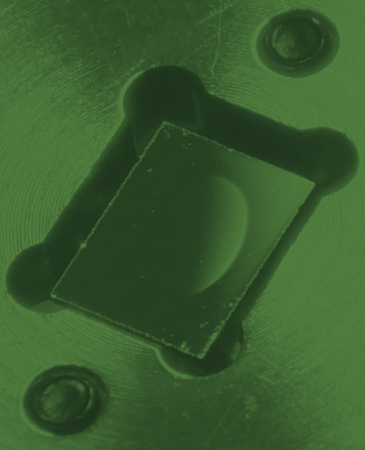
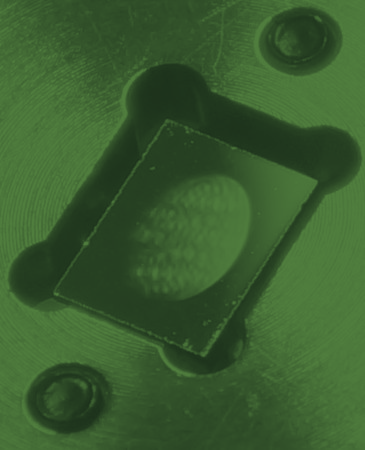
Phase-randomizing deformable mirror technology for laser speckle reduction — delivering unmatched speed, optical efficiency, and performance across a wide range of applications.
Laser speckle reduction without diffusers
Dyoptyka has developed an innovative solution for the reduction of speckle and other unwanted interference effects that can arise when using coherent light sources.
Our phase-randomizing deformable mirror offers a unique combination of advantages over alternatives such as moving diffusers and shaking fibers — delivering superior performance across every critical metric. Please refer to our Publications page for a variety of more detailed descriptions.
We would be happy to advise whether our technology is appropriate for your application. Feel free to contact us for a discussion.
- Speckle reduction performance
- Speed
- Optical efficiency
- Electrical efficiency
- Compact size
- Manufacturability
Tailored to your requirements
A typical first evaluation system comprises a 5 mm diameter deformable mirror, mounted in a Thorlabs KCB1 kinematic enclosure for protection and ease of alignment, and a small electronic control module. No device configuration or software is required. Included with the evaluation system is our consultancy and support to help you achieve the best possible performance in your application.
Subsequent evaluation systems can be customized to meet your application requirements — matched to your laser power, beam diameter, wavelength, pulse duration, and more.
Production and supply of larger quantities can be undertaken by our manufacturing partner — a globally-recognized leader in optical coatings and components.
Currently supporting wavelengths from 193 nm to 10.6 µm, with reflection efficiency up to 99%, CW optical powers up to 100 W, and pulse lengths as short as 1 µs.
Technical comparisons
Both approaches generate sequences of uncorrelated speckle patterns which sum to a more homogeneous intensity over the exposure period. A diffuser must have a short correlation length of surface roughness so that it does not need to move at impractically high speed. The consequent diffraction into wide angles can greatly reduce optical efficiency. The deformable mirror has a continuous surface with relatively long correlation lengths. Its effect can be understood as narrow-angle temporally-randomized divergence. Randomly-distributed deformations in the continuous surface at very high temporal frequencies lead to the generation of many uncorrelated speckle patterns — for example, within a single one microsecond laser pulse.
The spot on the deformable mirror (from where the incident beam is reflected) can be imaged into the entrance face of a stationary multimode fiber with high coupling efficiency. Sequences of uncorrelated modal patterns are generated at the fiber exit face which sum to a more homogeneous intensity over the exposure period. Shaking fiber can achieve a similar effect but with lower temporal frequency, longer fiber length, higher N.A., larger core diameter — and the risk of fiber failure due to dynamic fatigue.
Our systems are currently being used by customers with wavelengths ranging from 193 nm to 10.6 µm (with reflection efficiency up to 99%, depending on coating), with CW optical powers up to 100 W, and pulse lengths as short as 1 µs.
Projection and holographic display, microscopy, interferometry, photolithography, metrology, sensor calibration, target illumination, and many more customer applications — in both free-space and fiber-coupled configurations.
Articles & Presentations
Independent research
Some of our hundreds of customers have published articles and theses describing the use of our technology across various applications. Understandably their emphasis is on their own work. However this recent review of relevant technologies provides an in-depth, and independent, comparison:
Kompanets, I. and Zalyapin, N. (2020) Methods and Devices of Speckle-Noise Suppression (Review). Optics and Photonics Journal, 10, 219–250. https://doi.org/10.4236/opj.2020.1010023
Get in touch
We're happy to discuss whether our technology is right for your application. Please contact me directly with any queries.
Looking forward to hearing from you.